
Pennsylvania Supreme Court Reaffirms Statutory Employer Immunity: Subrogation Implications After Yoder

Subrogation professionals handling Pennsylvania claims should note the Pennsylvania Supreme Court’s October 23, 2025, decision in Yoder v. McCarthy Construction, Inc. In this recent decision, the Court reaffirmed Pennsylvania’s statutory employer doctrine, providing that a contractor may be immune from negligence liability as a “statutory employer” even where it never paid workers’ compensation benefits to the injured worker.
In workers’ compensation losses involving multi-party layered business relationships, statutory employer immunity should be one of the first issues considered, as it may determine whether subrogation recovery is viable before litigation begins. Yoder confirms that this threshold analysis remains critical in Pennsylvania and in other jurisdictions with similar statutory employer immunity frameworks.
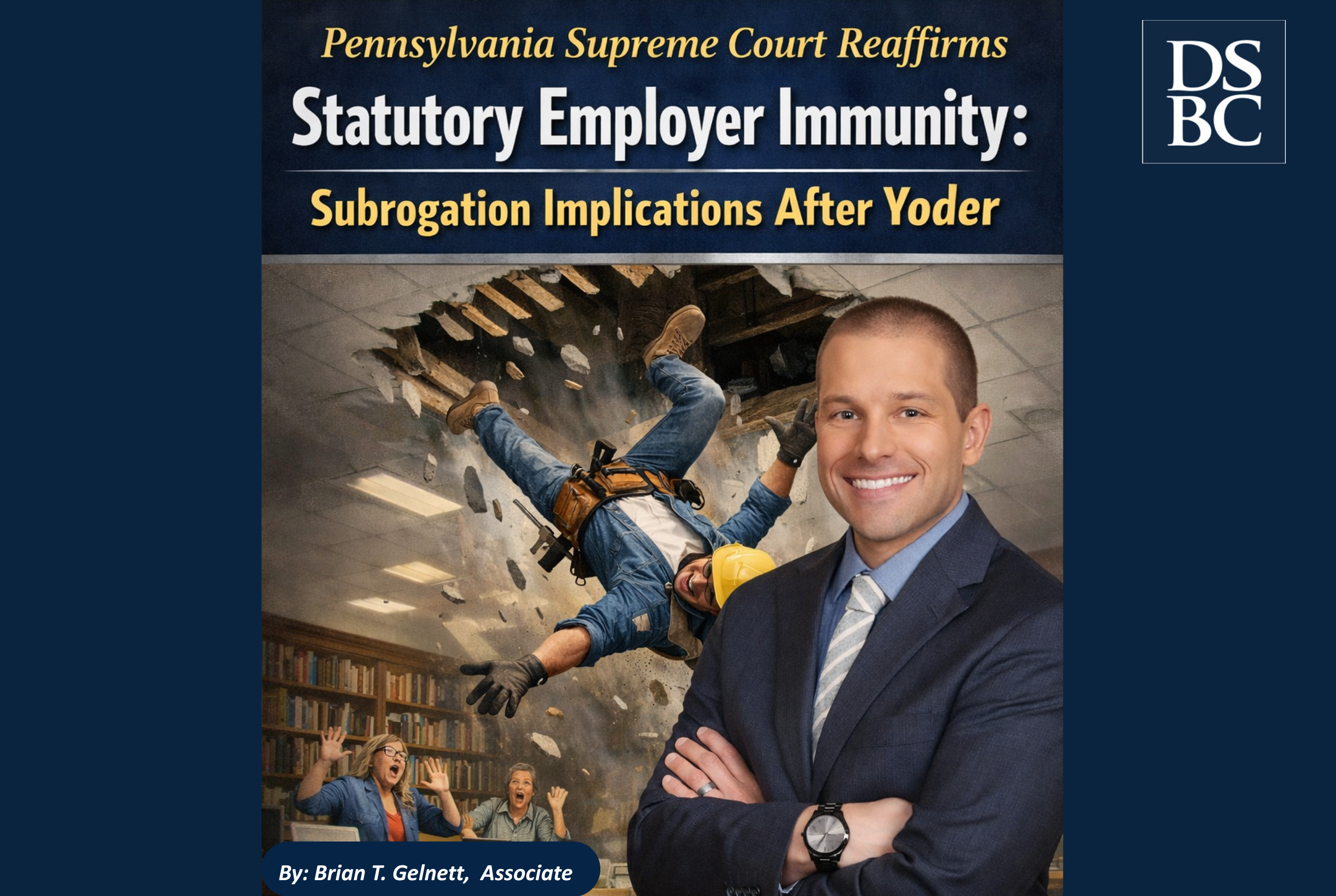
The Yoder case arose from a roofing project at a public library which involved an employee of a roofing subcontractor who fell through an uncovered hole and sustained catastrophic injuries. The injured worker received workers’ compensation benefits from his direct employer and later pursued a personal injury (negligence) lawsuit against the general contractor. The Philadelphia jury returned a $5,000,000.00 verdict in Plaintiff’s favor.
On appeal, the general contractor asserted statutory employer immunity under Sections 203 and 302(b) of the Pennsylvania Workers’ Compensation Act. The injured Plaintiff petitioned the Pennsylvania Supreme Court to alter existing precedent and require a contractor to actually pay benefits before receiving immunity. The Court declined and reaffirmed Pennsylvania’s statutory framework, which bars tort recovery against a qualifying statutory employer regardless of actual benefit payment.
Reaffirming its prior decision in Fonner v. Shandon, Inc., the Court held that actual payment of workers’ compensation benefits is not required for statutory employer immunity to attach. Instead, the Court remanded the case for further factual development on certain elements of the statutory employer test first articulated in McDonald v. Levinson Steel Co., the governing doctrine itself remains unchanged.
Pennsylvania courts apply the McDonald test to determine statutory employer status under a five-part test: (1) a contract with an owner or one in the position of an owner; (2) occupation or control of the premises; (3) a subcontract; (4) entrustment of part of the contractor’s regular business; and (5) an employee of the subcontractor. Courts must construe these elements strictly. However, if these elements are met, the entity is immune from liability as plaintiff’s statutory employer.
This ruling has practical consequences for all workers’ compensation claims involving a multi-layered employment setting in Pennsylvania and serves as a reminder to identify these potential issues early in all applicable contexts and jurisdictions.
While Yoder involved the most common construction context, statutory employer issues extend beyond traditional construction projects. These issues may arise wherever work is subcontracted or layered through contractual relationships, both express and implied. Maintenance contracts, industrial outsourcing arrangements, logistics chains, and employee leasing or staffing situations can all present potential statutory employer challenges.
For subrogation recovery purposes, immunity typically turns on contractual structure and control of the employee, as opposed to who paid worker’s compensation benefits. If the elements are satisfied, tort recovery against that entity may be barred regardless of the compensation payment history, barring both a personal injury recovery and a workers’ compensation subrogation recovery.
When a Pennsylvania loss involves contractual business relationships, the employment structure should be mapped as soon as possible because identifying potential statutory employer barriers early enables carriers to control costs and focus recovery efforts where they are most likely to succeed.
The injured worker in Yoder argued that Pennsylvania’s statutory employer doctrine unfairly shields negligent contractors who never paid workers’ compensation benefits from third-party liability. The Supreme Court acknowledged Plaintiff’s policy criticism but emphasized that any modification must come from the legislature, not the judiciary.
For subrogation professionals, the takeaway is practical. In Pennsylvania, and many other jurisdictions, statutory employer immunity is a threshold issue to be considered early in losses involving subcontracted work or shared employment structures. Addressing the issue early remains essential to cost-effective recovery strategy.
Footnotes
1. Yoder v. McCarthy Constr., Inc., No. 43 EAP 2024 (Pa. Oct. 23, 2025).
2. Id.
3. 77 Pa. Stat. Ann. §§ 52 (Section 203), 462 (Section 302(b)).
4. Domtar Paper Co. v. Workers’ Comp. Appeal Bd. (Kaminski), 32 A.3d 372 (Pa. 2011).
5. Fonner v. Shandon, Inc., 724 A.2d 903 (Pa. 1999).
6. McDonald v. Levinson Steel Co., 153 A. 424 (Pa. 1930).