
Interpreting the Vehicle for Hire Exception Under New York Insurance Law §5105

Under New York Workers’ Compensation Law § 29, a workers’ compensation carrier generally has a lien or right of subrogation from dollar one when an injured employee recovers from a negligent third party. But work-related motor vehicle accidents create a special wrinkle. New York Automobile Insurance Law § 5102 generally defines basic economic loss as the first $50,000 in medical and lost wage benefits (subject to certain caps and limitations), and Insurance Law § 5104 states that there is no right of recovery for basic economic loss. As such, when a workers’ compensation claim arises out of a motor vehicle accident, the first $50,000 is generally treated as non-recoverable through the ordinary subrogation recovery mechanism.
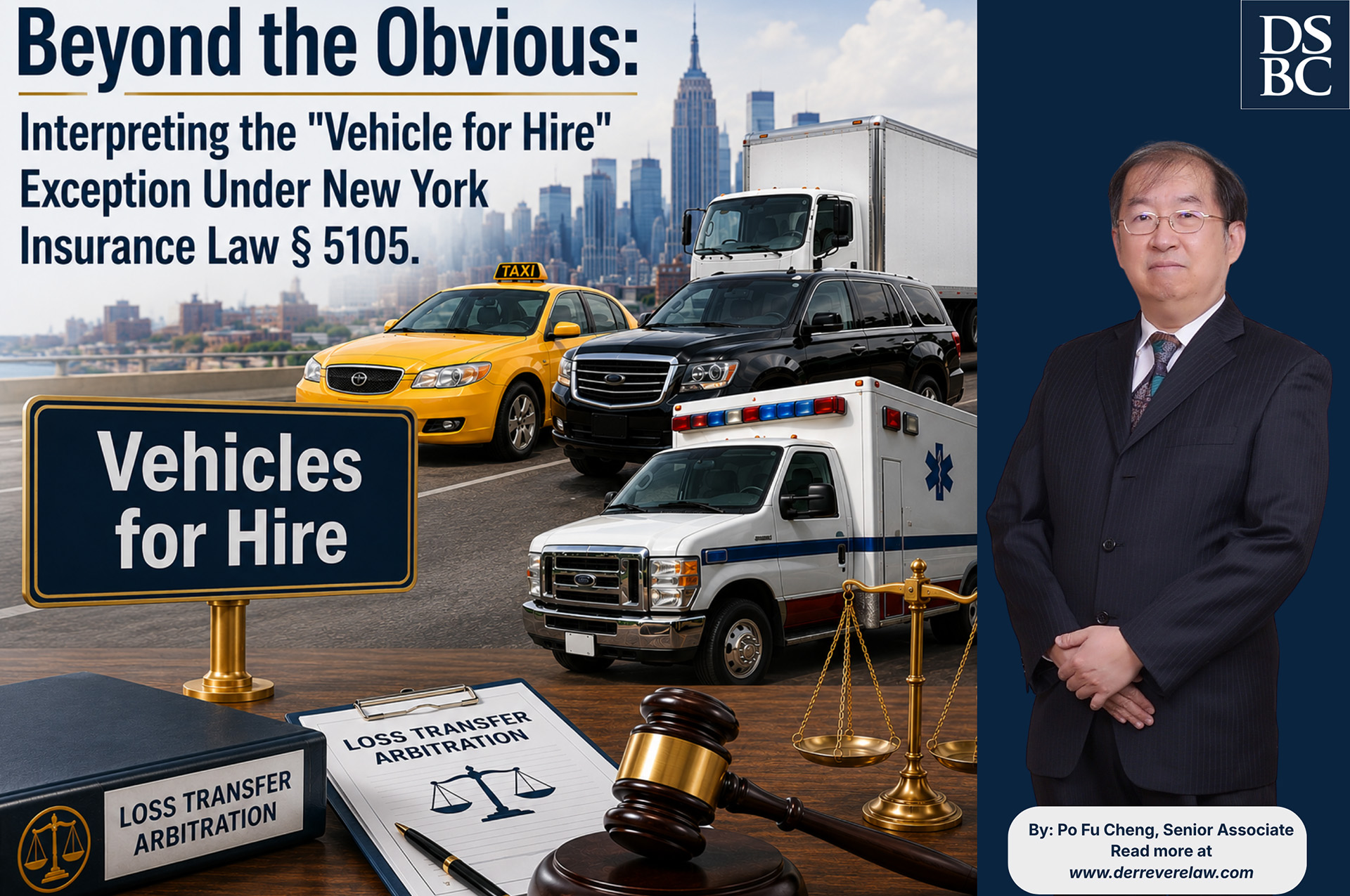
New York Insurance Law § 5105, however, creates an important exception to that general rule. When the underlying motor vehicle accident satisfies one of two statutory conditions, the workers’ compensation carrier may be able to recover basic economic loss payments through loss-transfer arbitration. The first condition is the weight exception: one of the vehicles involved must weigh more than 6,500 pounds unloaded. The second is the vehicle-for-hire exception: one of the vehicles involved must have been used principally for the transportation of people or property for hire.
Loss-transfer arbitrations are not decided through the regular New York court system. Instead, they are administered by Arbitration Forums, a private, not-for-profit organization created by and for the insurance industry. Unlike court decisions, Arbitration Forums decisions are not published and do not constitute binding legal precedent. This lack of published decisions means there is no reliable roadmap showing which facts or arguments prior panels found persuasive. That uncertainty creates room for creative advocacy, and it is often where a skilled lawyer can make the difference.
The weight exception is generally well defined and easier to apply. As such, this blog shall focus on the “vehicle for hire” exception, which sounds simple but is actually quite ambiguous.
For starters, New York Insurance Law § 5105 provides that a loss-transfer claim may exist when at least one of the vehicles involved “is a motor vehicle used principally for the transportation of persons or property for hire.” Sounds simple doesn’t it, but the statute does not clearly define what counts as “for hire,” leaving uncertainty about how far the exception reaches.
The New York State Insurance Department’s Office of General Counsel tried to address this ambiguity in a January 12, 2001 informal opinion, noting that “for hire” modifies the word “vehicle,” not simply “the transportation of persons or property.” In other words, the exception was not intended to cover every commercial vehicle or every business-related delivery, only those which perform the transportation service in exchange for compensation.
Even with that guidance, the issue remains unsettled. In Matter of Philadelphia Insurance Co. (Utica National Ins.), the Appellate Division admitted there was a paucity of judicial decisions interpreting “for hire” in the loss-transfer context and acknowledged that § 5105 is “inartfully drafted.” The court also made clear that the exception is not necessarily limited to traditional taxis, buses, or livery vehicles. As a result, whether a vehicle qualifies as “for hire” remains a fact-specific inquiry.
So how do you establish that a vehicle involved in an accident was actually “for hire””? A good starting point is to look at the vehicle’s licensing, registration, insurance, and regulatory paperwork. In New York City, for-hire vehicles such as taxis, black cars, liveries, and limousines generally must be registered with and licensed by the Taxi and Limousine Commission (TLC), affiliated with a TLC licensed base or fleet, and operated by a properly vetted and licensed driver. Statewide, taxi and livery drivers are generally required to hold a Class E license or an appropriate commercial driver’s license, and for-hire vehicles must maintain proper commercial insurance coverages. Inspection records may also matter, because TLC licensed vehicles must pass stringent inspections before they can take on paying customers. Taken together, these documents can strongly support the argument that the vehicle was not simply being used for personal or ordinary business purposes, but was being operated as a vehicle for hire.
But licensing and record search alone is not the end of the analysis. Even if the registration, insurance, or regulatory records search yielded no positive results, you can still persuade the arbitrators that a vehicle is in fact “for hire” through creative advocacy and careful framing of the facts. Relevant factors includes (1) whether the vehicle was primarily used for transportation, (2) whether it was offered or held out to customers for transportation services, (3) whether compensation was tied to the transportation, (4) whether the owner or operator was in the transportation business, (5) whether the driver was hired to perform transportation duties, and (6) whether the passengers or property belonged to outside customers rather than only to the vehicle owner or an internal group.
To illustrate just how fact-specific this analysis can be, and why the universe of potential “vehicles for hire” extends well beyond traditional buses, taxis, and limousines, consider an ambulance. An ambulance has registration, certification and driver licensing requirements similar to a taxi or limousine, and they provide transportation services for any member of the general public willing to pay the applicable fee. Those facts strongly support the argument that the ambulance is a “vehicle for hire” within the meaning of Insurance Law § 5105. The same reasoning may also apply, in varying degrees, to ambulettes, paratransit vehicles, commuter vans, community cars, rideshare vehicles, and other transportation or delivery service vehicles. Whether our argument is successful will depend on the specific facts of the case, but the key takeaway is that with the right factual record and persuasive legal framing, “vehicle for hire” can be much broader than the obvious examples.
In short, whether a claim qualifies for loss transfer under the “vehicle for hire” exception is often far from obvious. Success frequently depends on identifying overlooked facts and developing a persuasive legal theory tailored to the specific circumstances of the case. Derrevere Stevens Black & Cozad has extensive experience handling New York loss-transfer matters and has successfully recovered on numerous challenging claims for different insurance carriers. Our attorneys know how to identify unique recovery opportunities, develop the necessary factual record, and present the strongest possible legal arguments. If you are handling a New York workers’ compensation claim arising from a motor vehicle accident, consulting with Derrevere Stevens Black & Cozad early in the process can help maximize recovery opportunities, strengthen your arbitration position, and, in many cases, transform a marginal claim into a viable one.