
It Fits, But Is It Compatible? Replacement Chargers in Lithium-Ion Fire Investigations

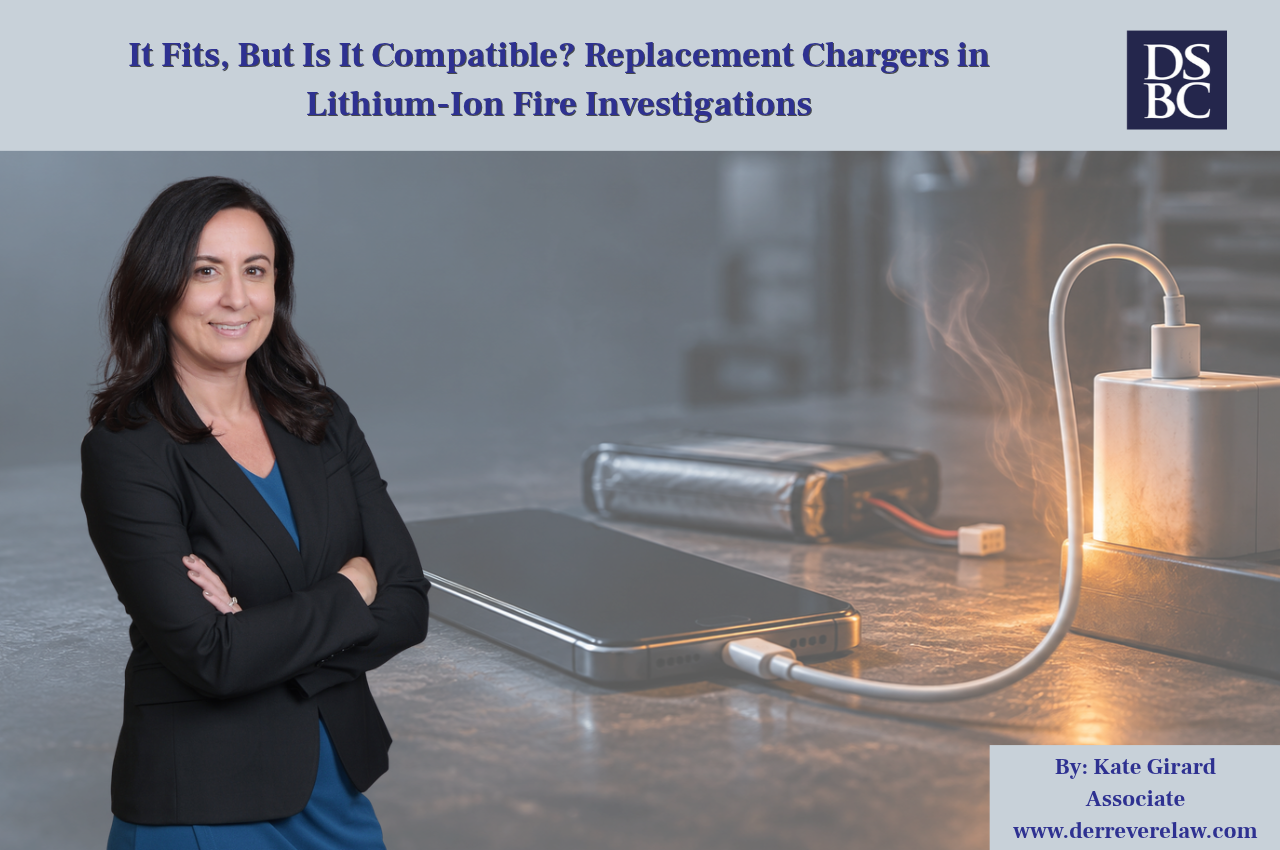
When investigating a fire involving a rechargeable lithium-ion product, one question can significantly change the direction of the investigation: was the product being charged with its original charger?
Consumers replace chargers all the time. They get lost, damaged, left behind, or mixed in with the growing collection of charging cords most of us have somewhere in our homes. It is pretty easy to find a replacement online, see that it fits the charging port and is advertised as compatible with the product, and reasonably assume that is the end of the inquiry.
For a subrogation investigation, it may be just the beginning.
A Charger That Fits May Not Be the Whole Story
Physical compatibility and electrical compatibility are not necessarily the same thing. A replacement charger may fit the charging port and appear to work while still not being appropriate for the particular battery and product.
The U.S. Consumer Product Safety Commission (“CPSC”) has specifically warned consumers about chargers marketed as “universal” for micromobility products. According to the CPSC, a charger may fit a device but still be incompatible with it because individual batteries have specific charging requirements. The CPSC recommends using the charger supplied with the product or a replacement that has been tested and approved to work safely with that particular device.
That distinction matters after a fire. The existence of a replacement charger should raise questions rather than answer them. Investigators may need to determine whether the charger was compatible with the product, whether the product’s internal safety features functioned as intended, and whether the evidence points to the charger, the battery, the product, or another potential cause.
Preserve the Entire Charging System
This is where early evidence preservation becomes particularly important. A badly damaged battery pack may naturally receive most of the attention after a fire, while an apparently undamaged charger can easily be overlooked or discarded.
The charger and charging cord should be preserved along with the product and battery remnants. Purchase records, packaging, photographs, manuals, and online product listings may also help identify exactly what equipment the insured was using and how a replacement charger was represented when it was purchased.
Online information deserves particular attention because listings can change or disappear while a claim is being investigated.
Follow the Evidence
The presence of a replacement charger does not establish that the charger caused the fire. It also should not automatically eliminate other potential causes.
The better approach is to preserve the evidence and allow the investigation to determine what role, if any, the charger played. In lithium-ion fire claims, something as ordinary as a replacement charger can become an important part of understanding how the loss occurred.
For subrogation professionals, the takeaway is simple: when preserving the battery-powered product, do not forget what was plugged into it.